USA BACKS OFF THE DECISION REQUIRING INTERNATIONAL STUDENTS TO TAKE IN PERSON CLASSES

The Trump administration took its decision back by forcing international students to take in-person classes or leave the country. It said it would no longer require international students to attend face-to-face classes in order to stay and study in the country. The cancellation was because of the outspoken criticism from universities, legal experts, and higher education advocates, who deemed the rules unfairly harsh for international students. 

Federal officials finally agreed to take back the policy which was implemented before earlier Tuesday, federal judge Allison Burroughs announced at the hearing for a lawsuit filed by Harvard University and the Massachusetts Institute of Technology on the past policy. National media channels recently reported that the White House was thinking about scaling back the decision after opposing by many universities across the country.

Highlights of previous policy regarding international student

Earlier in the last week, U.S. Immigration and Customs Enforcement declared that the holders of nonimmigrant F-1 and M-1 visas in the USA will not be permitted to stay in the country if they were attending the classes of the institutions online this fall.

ICE said they must either transfer to an institution having in-person instruction or else will face immigration consequences. Institutions in the USA which are following a hybrid education system would have to certify that students are not taking a whole course online in the fall to ICE.

The previous policy, which would have international students expelled if they did not show up for a class on campus, had thrown the higher education world into trouble with lots of confusion and disturbances at a time when universities in USA are struggling with whether to reopen campuses during this coronavirus pandemic.

Why was the decision taken back?

Two days after the decision was made, Harvard and the Massachusetts Institute of Technology filed the first of a petition of lawsuits for blocking the decision.

With Harvard and M.I.T., the attorneys general of 20 states, also sued, charging that the decision was useless, harsh, and reckless. A number of universities showed their support behind the lawsuit, along with many other organizations representing international students.

On Monday the pressure increased, when plenty of top companies, including Google, Twitter, and Facebook, also came forward to support the lawsuit, arguing that the decision would affect their businesses negatively.

The universities of the USA said that forcing international students to return to their home countries may separate them from their families in the USA, returning them to places where they no longer have any home. 

While filings in the court, universities said that some international students who were arriving already had been blocked from entering the country at airports by immigration officials as they said that their institutions were conducting classes online.

Even 15 Republican members of Congress signed a letter requesting the Trump administration to take back the decision regarding international students.

Reaction on the taking back the decision

After the announcement that the policy had been reversed, the officials of the universities applauded the decision and warned that they would be always ready to go back to court if there comes any further policy to restrict the ability of international students to study online.

Representative Rodney Davis, an Illinois Republican who had organized the letter, praised and said “right decision” to cancel the plan. “These hard-working students are the best and brightest from their countries, and they help our communities grow both culturally and economically,” he added.

Willow Cai, a rising junior at U.S.C. who has moved from China to the USA for studies, said that she had to rush last week to get herself registered for a golf class to ensure that she had a face-to-face class. After hearing the administration had reversed the existing decision, she expressed relief and outrage at the initiative of the government.

Harvard’s president, Lawrence S. Bacow said,  “This is a significant victory”. He added that the policy had disturbed all of the higher education of Americans. He also said that he had heard from a number of international students who said that the July 6 policy had put them at serious risk. He said, “These students — our students — can now rest easier and focus on their education, which is all they ever wanted to do.”

The president of M.I.T., L. Rafael Reif, said the swift opposition was evidence of the important role international students play in education, research, and innovative enterprises in the USA. “These students make us stronger, and we hurt ourselves when we distance  them.”

The University of Southern California passes a statement that it was thrilling to know that the government took back and reversed its rule that would have canceled the visas for international students.”

U.S.C., head of an alliance of 20 universities and colleges of USA on the West Coast which sued the government, said that international students deserve the right to continue their education in the USA without risk of deportation.

Losing the international students could have led to a huge loss of millions of dollars in tuition for the universities and also could have threatened the ability of the companies in the USA to hire highly skilled workers who often start their careers with American education. Each year, about 1 million international students get admission to the universities of the USA. Their share is around $41 billion per annum to the USA economy and supports more than 458,000 jobs.

Source:
https://www.jeduka.com/articles-updates/usa/usa-backs-off-the-decision-requiring-international-students-to-take-in-person-classes

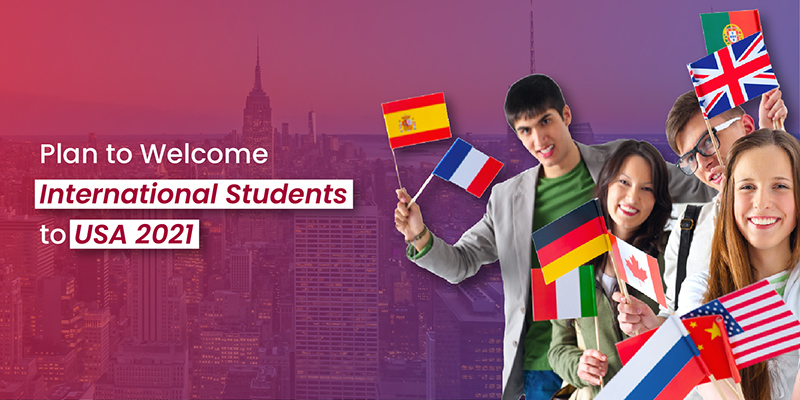
PLAN TO WELCOME INTERNATIONAL STUDENTS TO USA 2021

The USA has always been the most popular destination for international students from all over the world. It attracts nearly 1 million overseas students to the country every year. Due to the pandemic, the USA has seen a decrease in the percent of admissions of international students in American universities. So now America is planning to build back stronger. 


Statistics of international students in USA in the previous years

The report from the reputed Institute of International Education stated that the number of international undergraduate students decreased by 2.9% in the 2019-2020 academic year and this was before Covid-19. The overall newly enrolled international students decreased for the fourth consecutive year and total enrolled international students returning to pre-2016/17 figures. 

Challenges faced by America

It is not always possible to attract talented international students towards the US. Many of them choose the UK, Canada or Australia instead of America for their higher education due to many other reasons.

  • Policies such as the travel ban for some of the Muslim countries, and challenges in obtaining visas for a period of employment after graduation, etc become a hurdle in the way. 
  • The USA may find itself in a situation of war with other top study abroad destination for attracting the most important asset of the world,  talented young people.
  • There is a need for America to positively communicate its various strengths to a world. 
  • Canada has long welcomed international students,  The UK, position to signal a welcome to international students, by reintroducing a period of the automatic right to post-study work after graduation. In Australia, universities are trying to match these policies with attractive offers for international students. So there is tough competition in the world.

New policies for attracting International students

In the next four years, International students will get a much more supportive environment from the new president of the USA. He has repeatedly spoken about his commitment to providing international education.

  • One of the first actions the White House is expected to take after January 2021 is to lift the travel restrictions, but other actions are also likely to make a difference.
  • A commitment to stronger international cooperation and resolve to address the coronavirus pandemic through tighter public health measures.
  • The Presidents’ Alliance for Higher Education and Immigration, has prepared a series of proposals for the new administration’s first 100 days for the welcome of international students, such as: Implementing the existing International Education Strategy,  Addressing visa barriers to study in USA, and legislating for greater online enrollment flexibility.

Organisations such as NAFSA are hopeful that the new president team will open a new chapter in American international education. It will be challenging after a continuous decrease in international admissions for four years. Despite the many challenges awaiting a new president faced with overcoming a global pandemic and its impacts on the economy, education and global cooperation will be the centre point of the new policy commitment to ‘build back better’.

Reasons to choose America as your study abroad destination.

America has a spectrum of reasons to be proud of its reputation as a place of education. It has always welcomed international students wholeheartedly.

  • The American higher education system offers plenty of options to students according to their needs and interests. The universities in USA offer a wide range of study programs in all academic fields. 
  • An international degree from the USA opens up a wide range of career prospects. You will get a lot of job opportunities with the high packages after graduating from the university in USA. 
  • American universities offer excellent research and training opportunities to international students. 
  • The USA is an advanced technological country. It has equipped all spectrums of the education sector with the latest technology.
  • Almost all American universities provide good guidance and support to all international students. They help them in their accommodation, visa status, career opportunities, etc.

For students who want to widen their horizons and are brave enough to travel abroad for their students, America is the place for you.

Source:

https://www.jeduka.com/articles-updates/usa/plan-to-welcome-international-students-to-usa-2021

HOW TO CHANGE UNIVERSITY IN CANADA WHILE STUDYING ON A STUDY PERMIT

With a Canadian study permit, international students can change their school or program at any time without needing to apply for a new study permit. Once you are accepted into the institution you want to transfer into, you just need to notify IRCC. Keep reading the article to know what are steps you need to take and what will be the consequence if you do not move in the right direction.

How to Change University in Canada while Studying on a Study Permit


Conditions for your study permit on changing the University

You must inform IRCC each time you change post-secondary schools. Before starting your course, you must meet the following conditions of your Canadian study permit.


  • You must be accepted at a university in Canada listed in a Designated Learning Institution (DLI) 
  • You are actively studying while you are in Canada.


Requirements to update information to IRCC

You need to inform immigration authorities any time you change your University or program. To do this, you will need the following:


  • an online account
  • your study permit number
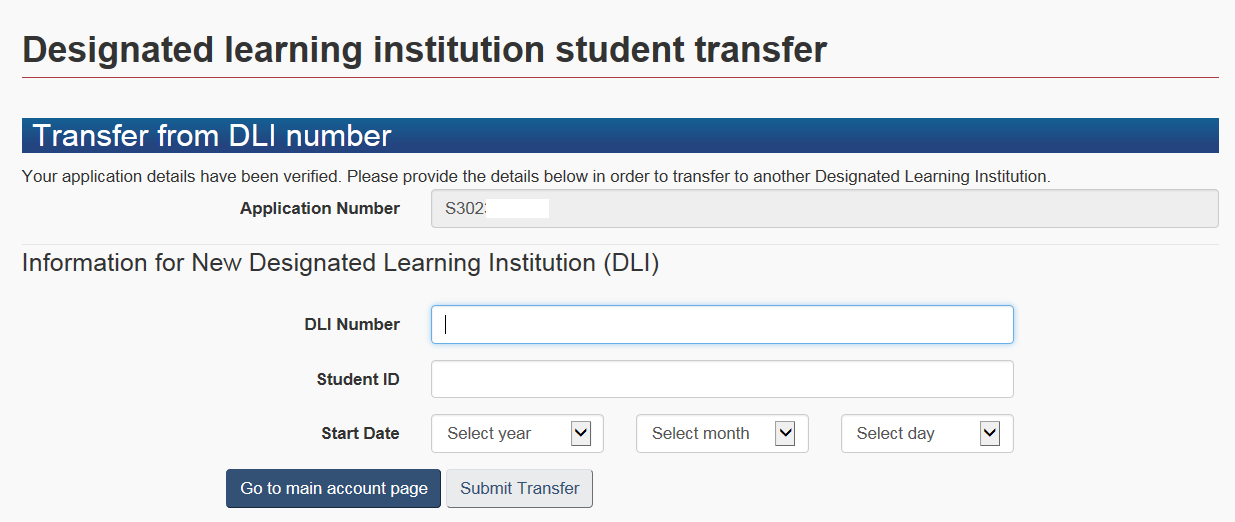
  • Designated Learning Institution (DLI) number of your new institution.
  • your new Student ID(Student Identification Number) mentioned on the new acceptance letter.
  • your start date at your new school.

They may ask you to provide any extra details from your application for security reasons, so be ready with all the information. You do not need any representative to change your DLI. If you have details of your study permit application, you can do it by yourself. 


Procedure to inform IRCC 

You have to contact Immigration, Refugees and Citizenship Canada (IRCC) if you:


  • are a post-secondary student 
  • have a co-op work permit and you have changed post-secondary schools to another co-op study program
  • need to update your study permit with the latest information.

If you are changing your institution, you will want to make sure you are following the right procedure and staying within the conditions of your study permit. Here are the steps you need to follow to change your school or program in Canada:

  1. Sign in to your account from here
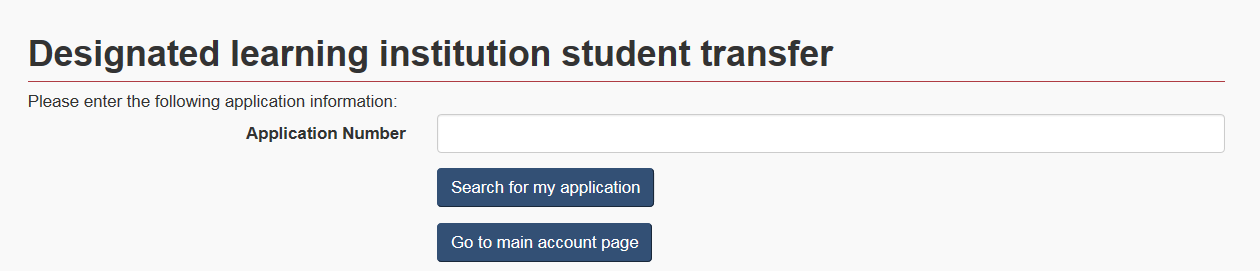
  2. Find the option Designated Learning Institution student transfer
  3. Click on the option transfer from DLI number

  1. Enter your study permit application number in the search option and then click search for my application

  1. You may be asked to enter some extra details from your original study permit application, fill it accordingly.

  1. Fill in the information about your new school or program, the new DLI number, your new student ID number, and your start date of the program.Click on submit transfer.


  1. You will then be asked to check all the information you have submitted. If everything looks good, you can complete the process by clicking confirm the transfer

8. You will receive a message or notification that your transfer request is complete. This means that you are successful in informing the authorities about your change of university.


Changing your DLI if you’re outside Canada

If you change your university before entering Canada and you don’t inform immigration officers about this, then you won’t be allowed to board your flight.


  1. If your application is still in progress

You can inform the authorities about your change of  DLI by submitting a new letter of acceptance using the IRCC web form.


  1. If your application has been approved

If your study permit application received approval and you want to change your DLI, you have to submit a new study permit application with a new letter of acceptance. You will also be charged a visa application fee again.


Studying in Quebec

If you are moving to a school in Quebec, you must get a Québec Acceptance Certificate (CAQ). If you are already in Quebec pursuing your course, you have to contact the MIFI (ministère de l’Immigration, de la Francisation et de l’Intégration) to change your:


  • University
  • Course
  • level of study

Consequences if you don’t inform IRCC

If you change schools and don’t inform IRCC, you may have to face few consequences. Your old institution will report as not you are being registered there to study. If this happens, you are breaking the conditions of your study permit


  • You may be asked to take an exit from Canada.
  • This will lead to preventing you from coming to Canada in the future.  Your Visa application form may not be approved in the future.

We hope you got your answer to Can I Change Schools or Programs While on a Study Permit? You should work legally to be on the safer side. Canada is an abroad country for you, so you have to keep your documents updated, especially visas and permits. You can stay to study in Canada only when you follow all the rules and regulation.  


Images source:- Canada.ca


Source:

https://www.jeduka.com/articles-updates/canada/how-to-change-university-in-canada-while-studying-on-a-study-permit

STUDY IN USA IN FALL 2021: US EMBASSY IN INDIA IS PRIORITISING STUDENT VISA APPLICATIONS

The US Visa Authorities in New Delhi are prioritising student visa applications. Isn’t good news for Indian students planning to join US universities in the coming Fall semester of 2021?. The embassy/ Consultant is taking active steps to ensure that the students from India could reach their destination, USA, on time before the commencement of their classes for Fall 2021.

Study in USA in Fall 2021 US Embassy in India is Prioritising Student Visa Applications


Fall Semester in universities in USA

At the universities in USA, the Fall intake begins in the month of August-September each year. Thus the US Embassy in Delhi is making efforts to prioritize student visa applicants to ensure that they can join the August-September semesters in time.


Students looking at study abroad in the USA will have to apply for either an F-1 or M-1 nonimmigrant status. International students who want to pursue academic studies in the US should apply for an F-1 student Visa. Those who want to pursue vocational or non-academic studies should apply for an M-1 Student Visa. Read more about US Visa here: Student visa in USA

Words of Donald Heflin, the US minister counsellor for consular affairs 

“I anticipate the number of applications this year to look similar to years past, and if that holds, we hope to be able to meet the demand for student appointments,” he also said “Our capacity is limited, as we continue to prioritise the health and safety of our customers and staff ”


Heflin also said that consular sections across India–at the embassy in New Delhi and the four consulates in Chennai, Hyderabad, Kolkata, and Mumbai are open for appointments in all non-immigrant visa categories, including student visas  H1-B, H-4, L-1, L-2, C1/D, and B1/B2 visas.

Important points for Indian students

At present, the appointments at the Visa authorities are open throughout the summer for USA student visa applicants. The US minister counsellor for consular affairs strongly suggests students apply early to ensure they can secure an appointment in time but keep in mind that you cannot apply more than 120 days before your program start date. The F-1 visa applicants should submit a valid I-20 form at the time of their visa application.


Rules for the Indian students planning to study in USA

Now, there are no entry restrictions for Indian students entering the USA holding an F-1 visa, according to the US embassy. The main thing to follow is that the Centers for Disease Control and Prevention (CDC) requires all international students entering the USA to present a negative Covid-19 test, which is taken within 72 hours of departure. 


Indian Students who are enrolled at universities in USA on March 9, 2020, who then took courses online can now re-enter the US, even if their school offers a distance learning program.


The head of recruitment in India, Shifali Kumar, University of South Florida said “Students who get a visa but cannot travel to the US will need a new I-20 form from their department with revised dates.


Source:

https://www.jeduka.com/articles-updates/usa/study-in-usa-in-fall-2021-us-embassy-in-india-is-prioritising-student-visa-applications


GERMAN UNIVERSITIES ARE OPTIMISTIC IN TERMS OF INTERNATIONALIZATION DESPITE THE COVID

A new survey by DAAD presents that the universities in Germany are optimistic about internationalization even during the Corona pandemic. The survey was taken among 171 German higher education institutions from 15 to 26 February 2021. It found that universities generally embraced digitalization in the 2020/21 academic year. 

German Universities are Optimistic in Terms of Internationalization Despite the COVID


Optimistic outlook on international mobility

The findings of the survey present that most of the German universities look to the future with hope. Around 50% of universities assume that internationalization at their institution will barely be disturbed by the Corona pandemic. Universities more than 20% believe that international mobility will gain more importance after the end of Corona. In addition, a clear majority of almost three-quarters of the universities expect that there will be a quick recovery in international student mobility once the travel restrictions are removed.


Around 32% of universities assume that the attractiveness of Germany as a study abroad country has increased as a result of Corona compared to other study abroad countries. Only 9%  of the universities expect it to get worse. 


Teaching methods during covid

80% of universities in Germany began the winter semester of 2021 with a hybrid model of teaching which is a mix of face-to-face and online instruction. Only 16% of universities stuck to virtual teaching. However, with the time only a good 41% of universities stuck to the hybrid model until the end of the semester, the remaining 40% eventually opted for purely virtual teaching in the semester.


Agreements with the USA, Canada and Finland

According to the survey, 26% of german universities entered into new cooperation agreements with universities of other top study abroad countries in the past two Corona semesters. The USA, Finland and Canada are its main targets. The goal of this was to help students to participate in courses abroad online.


International students could not enter Germany due to a decline in visa application

Maximum Respondents said that up to half of the new international students were unable to enter Germany in the winter semester despite having been admitted. Around 14,700 international regular students and 2,300 guest and exchange students did not obtain a student visa for Germany in the 2020/2021 winter semester. Around 50% of the German universities offered the option of taking back with a full fees refund to the students.


As per German universities, the students which are particularly affected are from India, Iran, Bangladesh, Pakistan, China and Nigeria. Approximately 3 quarters of the universities offered distance learning by facilitating online courses. Along with this, around 50% of the universities surveyed said that during the past two semesters about 1 out of 2 of their students staying abroad has postponed or cancelled.


DAAD President Prof. Dr Joybrato Mukherjee, notes:

“German universities have acted quickly and courageously to minimise the negative impact of the Corona pandemic on their internationalisation activities as much as possible”. He also added “Despite major challenges in the entry of international students and the ongoing travel restrictions, only 5% of all universities completely suspended their international exchange programmes in the winter semester.” Continued saying “A quarter of our member universities were even able to establish new digital collaborations abroad due to the advancing digitalisation.”


General effects of COVID-19 pandemic at German universities

The Corona pandemic has made a serious impact on various activities and courses offered by German universities. The main effects are:

  • Many Non-teaching events were cancelled at universities in Germany. 
  • Official trips within Germany were reduced to a minimum. Around three quarters (72%) of the universities reporting cancellations likely to be due to cancellations by the respective local organisers. 
  • Many Campus buildings and offices were closed.
  • Plenty of Exchange programmes were cancelled. 
  • 50% of the universities postponed the beginning of the winter intake, because of national regulations. 
  • Around 62% of the German universities did not cancel their study abroad and exchange programmes in the winter semester of 2021, while 33% of the universities have discontinued only a few programmes. 

 Action against COVID-19 pandemic at German universities

German Universities are Optimistic in Terms of Internationalization Despite the COVID


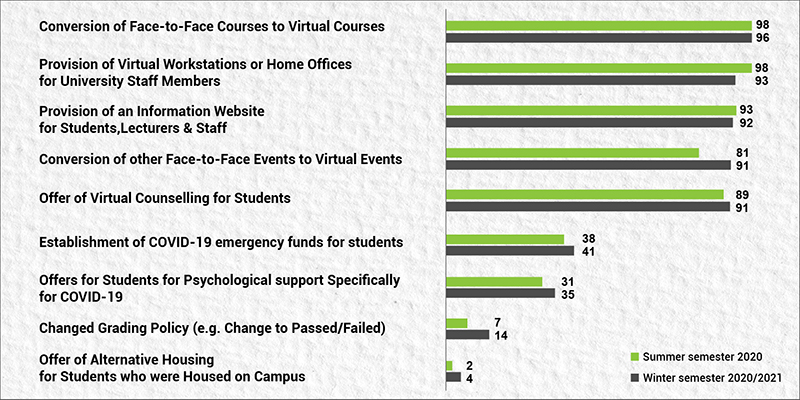
  • Since the beginning of the COVID 19 pandemic, 9 out of 10 German universities have converted their teaching to online courses at least partially. By facilitating their staff with virtual workstations (93%), building an information website on the topic, offering virtual counselling for students (91%), they made it possible. 
  • 91% of the face-to-face events were converted into online events. 
  • Around 74% of german universities switched at least partially from face-to-face to online exams.
  • Two-thirds of the universities created a Corona contingency plan. An emergency fund for students was set up, psychological counselling specifically for students with pandemic-related problems are also made available.

Sounding optimistic, the majority of German universities believe internationalization is going to be important in future. Once travel restrictions ease, a quick recovery will happen. The universities in Germany are delicately supporting international students. The majority of universities are strongly working according to the needs of international students.


Sources:

https://www.jeduka.com/articles-updates/germany/german-universities-are-optimistic-in-terms-of-internationalization-despite-the-covid


STUDY ABROAD WITH IELTS AND GMAT

One of the most important things that affect one’s decision of college is exam scores. One might argue that one’s profile is equally important. But in the majority of cases, colleges tend to screen you primarily by your exam scores. It is only when you are close to the cut-off and they are feeling particularly benevolent that they decide to give your profile a glance. It is understandable how much of an impact one’s profile would have on the selection criteria at that point. But before that, understanding that exam scores take precedence is of paramount importance.


The results from these exams offer a wide array of colleges to choose from. But the exam choice also affects the same because the acceptability of certain exams is limited to certain colleges only. Therefore, when considering colleges and courses, choice of exams is an important thing too. Ideally, universities in English-speaking countries require students to have proof of proficiency in the English language. For that, primarily there are two exams while others are less common- Test Of English as Foreign Language (TOEFL) and International English Language Testing System (IELTS). These exams help a university to assess a student’s ability to survive in the country.


study abroad with IELTS and GMAT


For actual entrance examinations, very few universities have their own exams. The majority have accepted one or the exams conducted by independent boards as acceptable exams. One of those exams, suitable for management and arts courses is Graduate Management Aptitude Test (GMAT). Other exams, for more technical courses, include GRE, etc. While some management universities accept GRE as an acceptable exam, the GMAT is the preferred one. It is nice to understand a certain background about these exams.


IELTS primarily tests the students about proficiency in English in four different areas- Writing, Speaking, Listening, and Reading. Comprehensively it helps in providing a score that is indicative of the student’s proficiency in the English Language. IELTS tests students on various dialects and accents such as British, Australian, and New Zealand, etc. Most universities have a requirement of a score slightly above 6 over 9.


GMAT, on the other hand, is an aptitude test that is primarily preferred by management aspiring students, or those aspiring for admission into one or the other forms of Arts courses such as pure finance, economics, etc. It basically tests a student on English, reasoning, and logic, and mathematics. While is an adaptive test whose difficulty increases or decreases basing on the way an aspirant is answering, most first-tier colleges require a score of 650 and above over 800. It is one of the most widely accepted exams with over three-fourths of the colleges in most of the English-speaking countries accepting the examination.


While GMAT and IELTS both have English testing, the aspects that are tested as well as the pattern of testing are widely different. The validity of the exams varies too. While GMAT is applicable for 5 years, the scores of IELTS are valid for only two years. Therefore, students, while attempting the exam have to plan accordingly. Logically looking at it, it would seem that one would have to prepare for GMAT and then IELTS. GMAT tests one on comprehensive passages, understanding of sentence structures, and vocabulary usage while IELTS is primarily focussed on how well you understand English as would be spoken in the host country. GMAT is primarily focused on assessing your grasp of English by ensuring you’re equally good at all aspects of the language while IELTS only wants to ensure you can survive in the host country. Therefore, the method of preparation is quite different.


However, why IELTS is a question that arises when TOEFL is equally valid and accepted. Most of the USA accepts TOEFL as a first preference. However, outside the USA, IELTS is the preferred one in countries such as the UKAustraliaCanadaNew Zealand, etc. Let us take a look at some of the top colleges that accept IELTS and GMAT combination for Management courses.


Top Universities Accepting GMAT and IELTS

While it is interesting to note that IIM Ahmedabad, India, the premier management institutes in India accept IELTS scores, they still require you to get a certain score on Common Admission Test (CAT), the country’s most sought-after entrance exam.

However, it is important to note that most schools mentioned on the top 10 list require you to possess a score of about 700 in GMAT over 800 and a score (the class average for the past years) of 7-7.5 in IELTS which funnels only the creamy layer into these colleges. It is for these reasons that these colleges are well sought after and the exams receive such hype for preparation. Proper planning and lots of practice are required to ace these exams.


Source:

https://www.jeduka.com/articles-updates/study-abroad/study-abroad-with-ielts-and-gmat


DOES GOOD GRADES AFFECT STUDY ABROAD?

A most usual question of students about study abroad is do I require good grades to study abroad? The answer relies upon where you need to study.


study abroad colleges


Language courses abroad


If you want to go for a language course at a language school abroad you normally don't need to stress over your grades. Language schools exist to help international students to learn a language regardless of their educational background. So when you apply to a language school abroad you don't have to submit any grades.


The only exemption is whether you need to study with a student visa in some nations. At that point, you usually need to prove that you have finished secondary school. On the off chance that you take a language course at a college, you may also need to present a secondary school certificate. But if your primary goal is to improve your practical language skills then you should take language courses at private language schools where the classes are smaller and there is more focus on the conversation. check all the study abroad courses here


Community college


Community colleges work on an open admission strategy which implies that anybody with a high school diploma can be admitted. In some countries, you don't even need to have finished high school as long as you can prove that you will benefit from the course.


Universities


If you need to study at a college abroad you will dependably need to submit your high school certificate with the application and also transcripts from college studies in your nation of origin.


Though, do you need good grades to become accepted? That relies upon what college and which program that you are applying to. To get accepted at top-ranking colleges abroad you should have better than average grades. The same can be valid on the off chance that you want to become a doctor or study at other truly well-known or demanding programs. But if you don't apply for the best ranking colleges it is normally not hard to get accepted as long as you have decent grades.


Which grades are most important when I want to study abroad?


In the event that you will study in an English-speaking nation, it is clearly essential that you speak great English. However, you don't really require decent grades in English since you can prove your English abilities by taking a TOEFL or IELTS test. In the event that you’re English is not good enough you can start by taking a preliminary English language course.

Generally, the most important subjects are the ones that are related to what you need to study. Core subjects like Mathematics are frequently essential since it is important for some majors like Programming, Engineering or Economics and so on. A few schools even give their students a math test on arrival to figure out which courses they can take.


Schools don’t only look at grades


However, your grades are not all that matters. Even if you have straight A's you won't be admitted to a prestigious design school if you can't convey a good portfolio. In the meantime, a student with average grades but a great portfolio might very well be admitted. For design-related subjects, many schools request that the students present a portfolio with their application.


Schools frequently request a personal letter and letters of reference which will also impact whether you get acknowledged or not. Different schools request entrance tests like SATs. Ensure to put the effort into your application and submit everything that the school requests. The surest approach to not get accepted, regardless of your grades, is to present an incomplete application.


Source:- 

https://www.jeduka.com/articles-updates/study-abroad/does-good-grades-affect-study-abroad