Showing posts with label Study in Canada. Show all posts

List of Documents Required for Applying to Canadian Universities

When you apply to a university in Canada, the first thing that comes up is the application, which can be overwhelming. It requires time, patience, and careful planning. This article will present you with the List of Documents Required for Applying to Canadian Universities. 


1. Documents Required for Applying to Universities in Canada


By checking the below-provided Checklist for Canada, organize all your documents before applying for admission to any University in Canada.


2. Application Form


The Application form is the entry form you must fill out carefully to get admission to your selected university. You can fill out the application forms online or offline, depending on the availability of the application forms. Some universities offer an online application process, while others offer paper application forms on the university’s website.


3. Passport size Photographs


You must focus on these photos even though it appears to be simple to obtain. To apply, you must submit the most recent photographs in the proper size. If the appropriate-sized pictures are not attached, your application may be rejected.


4. Academic Certificates


You need to send the academic certificates supporting your educational qualifications along with the application form. If you have just completed your higher secondary studies and are applying for undergraduate studies, you need to send the SSC and higher secondary certificate to the university. And, if you have completed a bachelor’s or Master’s Degree, you need to send your certificate and the mark sheets. The AcademicCertificates include


  • 10th Grade Transcripts & Certificate.
  • 12th Grade Transcripts & Certificate.
  • Bachelor’s Transcripts & Degree (for Masters/PG Programs Only).
  • Master’s Transcripts & Degree (if available).
  • Diploma Transcripts & Certificate (if available).
  • Other Diplomas/Certificates (if available).


5. Competitive Exam Scores


For admission to Canadian Universities, you must take some entrance exams like IELTS/TOEFL/GRE/GMAT/SAT. Depending on the course you are applying to, you need to take the respective exam and send copies of the Scores supporting the required entrance exam. 


  • For any of the courses, you may require to take the English language tests to prove your English proficiency.
  • For any undergraduate courses in Canada, you may be required to take the SAT, and for the postgraduate course, you need to take the GRE Exam. But to pursue any business program at Canadian University, you may be asked to appear for the GMAT Exam. 


6. Statement of Purpose


The Statement of Purposes is a brief essay that outlines one's professional and research objectives as well as any steps they have taken thus far to achieve them. You must explain through your SOP why you chose this course, why you chose that specific university, what you want to do after the course, your interests, and other personal information. Your admission to the university will depend on having a strong SOP. So give yourself enough time before submitting the SOP.


7. Letter of Recommendation


A letter of recommendation is one that we ask someone to write for us. As People always want to know what others think about them, universities ask for Letters of Recommendation form to assess the qualities, Characteristics, and capabilities of the person to perform a particular task. Find the ideal candidate to approach for a reference letter so you can win an entrance. You will fall down the ladder with a depressing recommendation letter.


8. Experience Certificates


If you are applying for any Business Program, you must have experience in the relevant field to get admission to any Business School in Canada. If you are applying for any undergraduate course in Canada, you don’t need to have any experience. The significant documents in proof of work experience include


  • Latest Joining Letter.
  • Latest Salary Slip.
  • Employment Certificates from all Previous Employers.


9. Resume


Along with all the above-mentioned documents, you also need to send your resume with details like your educational background and skill sets. Making a strong CV is always a smart move. Getting help while preparing your resume for the most powerful one is wise


10. Bank Statement


To be accepted by Canadian Universities, you also need to prove that you have the financial ability to clear your College Fees. Therefore, you must give a copy of your bank statement that is stamped with the manager's name, date, and account number.


11. Affidavit of Support


Stamp Paper duly signed by the Sponsor stating that they will be sponsoring your studies in Canada should be submitted along with the application.


12. Additional Documents


You may submit any other documentation you may have in addition to those listed in this Checklist, such as paper presentations, examples of your symposium organization, etc. The smallest award will push your application a little more challenging. Therefore, send certificates outlining your skills and extracurricular activities.


The specific documents required vary depending on the university and program you are applying to, so be sure to check with the school for their specific requirements. However, most Canadian universities will require some or all of the above-mentioned documents.

Source:

https://www.jeduka.com/articles-updates/canada/list-of-documents-required-for-applying-to-canadian-universities


8 Reasons to do Postgraduate Studies in Canada

Canada is one of the best places to do postgraduate studies. With a myriad of universities and colleges, Canada boasts of having some of the best postgraduate educational institutes in the world. As a result, this country attracts many students from all over the globe. The number of international students who enroll in Canada is steadily increasing. Many stay after completing their coursework and even become permanent country residents.


8 Reasons to do Postgraduate Studies in Canada


8 Reasons to do Postgraduate Studies in Canada

Canada is a prime location for postgraduate study with its diverse and stunning landscape and ability to reinvent itself continuously. This goes hand-in-hand with Canada's stability and the security and quality it offers, making it one of the top countries in the world to explore and learn more while earning your degree. Here are the main reasons for studying in Canada:

1. Academic excellence

The high quality of education is one of the most important reasons students study in Canada. A degree from a Canadian university is an indication of academic achievement, as well as a trust that the university will provide quality education. In the QS World University Rankings 2023, 30 Canadian universities are ranked.

2. Ample research opportunities

One of the main reasons why Canadian education is so distinct is its emphasis on research and development. There is no better country for a research scholar than Canada. The Canadian government provides significant funding for research in the fields of medicine, telecommunications, agriculture, environmental science, and technology.

3. Affordable falls in the budget

Compared to universities in the United States and the United Kingdom, tuition in Canada is relatively low. And, in terms of return on investment, it is a viable option for Indian students. You can also apply for various Canadian scholarships to help you save money on your education.

4. Cultural diversity

In Canada, you'll find extremely friendly and welcoming people from various ethnic groups, each with their own culture and way of life. Canada's multicultural environment promotes friendliness and peaceful living like no other country. In fact, many Indians are studying, working, and living here. You can also attend festivals and rituals such as the Montreal International Jazz Festival, the Calgary Stampede, NHL Hockey, and the Just for Laughs Comedy Festival in Montreal, among others.

5. Safe and peaceful

Canada has repeatedly been ranked as one of the world's safest countries. The Global Peace Index ranked Canada as the world's 12th most peaceful country in 2022. As an international student, you have the same rights and privileges as any other Canadian student.

6. Earn while you learn

Canada allows all international students to work up to 20 hours per week during their semesters and full-time during their summer and winter breaks. You would not need an additional work permit to work on campus or as an intern in any company because your study permit is sufficient to help you find a part-time job.
 
International students can work in Canada as long as they have a valid study permit. There are also many jobs for international students at universities and colleges, including teaching and research assistants. There are more job opportunities in the private sector than in the public sector.

7. Vibrant and lively campus life

Canada's universities are a vibrant and lively community where students can develop the skills needed to succeed in today's globalized environment. There are many activities to partake in and meet new people. The students have a lot of fun with the activities such as dance parties, sports games, club meetings, etc. This creates a happy and lively environment for all students, assists you in networking and meeting new people, and keeps homesickness at bay.

8. Immigration opportunities

The Post-Graduation Work Permit Program (PWPP) in Canada allows students to stay and work in Canada for up to three years after graduation. You can gain international work experience and later apply for permanent residency.
 
In addition to its renowned reputation and excellent education system, Canada offers a wide range of options for postgraduate studies. Students can choose from various institutions that offer different programs and career tracks. The country has a good infrastructure and is well-connected to other countries through multiple modes of transportation and communication systems.
 
Ultimately, there are many reasons why students should consider postgraduate studies in Canada. The list above provides a few examples of what to expect and the benefits students can reap from studying here. Canada is a beautiful country to do postgraduate studies and offers incredible opportunities for students from around the world.

Source:

Canada to Extend Work Permits to Former International Students

The Government of Canada recognizes the huge social, cultural, and economic benefits that international students bring to Canada. Thus, the Canadian government has announced that former international students, whose work permits are expiring, will be offered the opportunity to work in Canada for another 18 months.


Every year, more and more students from around the world are choosing Canada to pursue their education. Canada is known for its diverse and inclusive society, high-quality educational institutions, and opportunities to work or immigrate after graduation. The
 Immigration, Refugees and Citizenship Canada (IRCC) is taking measures to help former international students with expired or expiring post-graduation work permits, and for the temporary resident to permanent resident pathway applicants.

Open work permits for individuals with expired or expiring post-graduation work permits

Foreign nationals who have post-graduation work permits that expire from September 20, 2021, to December 31, 2022, will be able to work in Canada for an extra 18 months. This can be done by either extending their work permit or applying for a new one. Those currently in Canada will also be able to work while their permit is being extended or a new one is being issued.

Ability to work in the interim

Beginning August 8, 2022, individuals holding post-graduation work permits that have expired or will expire from September 20, 2021, to December 31, 2022, will receive an email confirming that they are allowed to work in the interim. 

Recipients who are eligible for the additional 18-month work period can use this email attachment as proof to their employers that they are authorized to work temporarily in Canada. This is a one-time measure put into effect to make sure those eligible can either stay working or return to the workforce while they apply for a new work permit. The interim work period will last until May 31, 2023.

Work permits for applicants to TR to PR pathways

Applicants who are part of the temporary resident to permanent resident (TR to PR) pathways, and whose permanent residence application has not yet been approved, are eligible to apply for an open work permit. This assures that they will not lose their status or capacity to work while their permanent residency application is being processed.

  • Recognizing that the processing of TR to PR applications would take some time, those applying for an open work permit can now get one with an end date of December 31, 2024, as long as their passport is valid until then.
  • Applicants whose passports expire before December 31, 2024, will not receive email and will be ineligible to extend the duration of their present work permit under the exceptional measure. They are still entitled to apply for a longer work permit, either to match the date their passport expires or to apply after they have replaced their passport.
  • If the individual has to amend their mailing address, or if they opt-out of receiving an open work permit through this process, they will no longer be eligible for the special measure.  They will be required to apply online.

This is a very positive step for many former international students who have studied in Canada and obtained their permits but were unable to fully utilize their work authorization due to the circumstances of the pandemic and other delays. While many students are already interested in staying and settling in Canada, there are often hurdles due to the limited timeline so this temporary extension for specific holders is beneficial for many students who like to continue to expand their careers.

Survey says Canada's Safety and Quality are Top Attractions for International Students

The latest survey from the Canadian Bureau for International Education (CBIE) highlights the challenges and opportunities faced by international students in Canada. These are “from pre-arrival planning through study and post-graduate phases.” The study shows that Canada’s perceived safety is a major draw for international students.


Canada�s Safety and Quality are Top Attractions for International Students


Highlights of the Survey

CBIE is Canada’s international education association which includes members from school boards, colleges, language schools, institutes, polytechnics, and universities. This time it was the 6th year CBIE has conducted its International Student Survey (ISS), and the highlights of it are:

  • This year the survey involved the participation of 67 institutions across Canada. 
  • Around 40,000 international students from multiple source countries participated in the survey between October & December 2021.
  • It showed that most students are satisfied with their experience of studying in Canada.
  • There are several competitive advantages for Canada in 2022, the most powerful being its reputation for being safe.
  • Also, most would recommend Canada for abroad studies to other international students.


Top Reasons for Wanting to Study in Canada

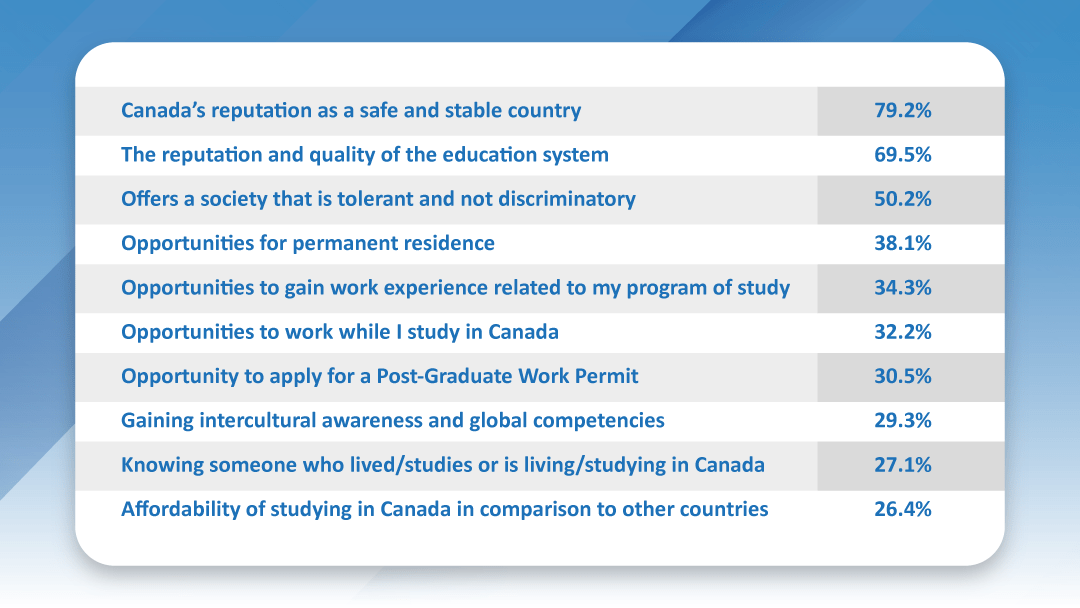
The Survey disclosed several competitive advantages for Canada in 2022. The most influential is its reputation for being safe (79%). International students have ranked safety and tolerance higher even than those related to the work or immigration policies that have helped Canada to become a top tier of study abroad destinations in recent years, as illustrated in the following image.


Canada survey


Different levels of Significance of International Students 

CBIE has written broadly about the importance of building  Student-centered attractive university websites and results from this survey highlight that point. The different resources assume different levels of importance according to the country of origin. For example, Students from China are highly influenced by peer recommendations relative to Indian or French students, students from France are likely to consult a school’s website, and students from India are more likely to seek the advice of consultants.


Students generally satisfied with arrival services

Most international students were comfortable with their experience of arriving in Canada and comfortable with campus life. Not even the difficulty and strangeness of quarantining due to the pandemic became a real problem. At the same time, survey results reveal that Canadian universities could do more to welcome students at airports and on-campus, and help them move into the residence. 

Only about 3 students out of 10 said they were “very satisfied” with the arrival services of their student experience. First impressions count for a lot, so it is important to ensure that universities are putting their best foot forward during these initial moments by presenting themselves as an institution that can be fully trusted.


Many Experience Challenges in Finding Employment

The report notes that a substantial number of respondents attributed their difficulties finding work to their incapability to understand the expectations of Canadian employers and to their future employers being unfamiliar with regulations for hiring international students.

CBIE says, “These findings point to where institutions can play a more proactive role, which might include institutions providing expanded job readiness training for international students and ensuring a gender focus in this training” adding to that, it said, “ Institutions may also consider increased outreach to employers and community groups about how to hire international students or develop information products on hiring rules that international students can share with prospective employers.”


Post-Graduation Plans

Many International students carry long-term plans in their mind when they decide to study in Canada.

  • More than four students in 10 want to work and then immigrate; 
  • More than a quarter of students want to work, then continue to further studies; 
  • 1 in 5 students plan to continue studying at their Canadian university; 
  • 18% of students intend to work in Canada for 3 years before returning home.

Highlighting the huge importance of the Post-Graduate Work Permit(PGWP) to Canadian institutions’ recruitment arsenal, close to three-quarters of the more than 40,000 international students surveyed plan to apply for PGWP to allow them to look for employment in Canada for up to 3 years. Another 6 students out of 10 (59.4%) intend to apply for PR(Permanent Residency).


Source:


https://www.jeduka.com/articles-updates/canada/survey-says-canadas-safety-and-quality-are-top-attractions-for-international-students

Attractive Facts That Will Make You Want To Study In Canada

Canada is one of the most popular countries for international students looking to obtain a study degree. It has several higher education institutions for international students. It is home to some of the best universities in the world. Here we have mentioned a few Attractive Facts That Will Make You Want To Study In Canada.


  • The quality of higher education in Canada is one of the main reasons students choose Canada. A Canadian degree is often considered on par with those earned in the USA, Australia, or the UK. Universities in Canada routinely rank well in worldwide rankings.
  • Canada has an excellent academic track record with a high employment rate.
  • The benefit of studying in Canada over your home country is that it focuses on research and development.
  • Along with a strong educational system, Canada also has natural beauty, which may make your stay memorable.
  • Canada is home to magnificent coasts, majestic mountains, and exciting woods.
  • Canada is the world’s second-biggest country, and it offers a diverse nightlife and delicious cuisine scene added to its natural wonders.
  • Multiculturalism can be Experienced in Canada's wide range of art, music, food, literature, and cinema.
  • Canada is ranked 1st among the world’s safest countries by US news 2021 Best Countries rankings. It is one of the happiest countries to live in.
  • Since Canada has one of the most significant economies in the world, graduates will have many job opportunities. You will have the opportunity to network with experts in your profession being an international student.
  • While you Study in Canada, you may obtain experience working for some of the leading firms during your program or after you graduate.
  • If you decide to come back to your home country, your Canadian education and increased language skills will help you find a job in multinational corporations.

Canada has everything you need for your successful future career, excellent academic instruction, a safe and diversified environment, and a welcoming cultural life. Every year, nearly 120,000 international students come to Canada from around the world. With so many benefits, it’s no surprise that a growing number of international students are choosing to study in Canada.

Canadian Government Offers Scholarships to International Students for 2022-23

The Government of Canada is offering scholarships for the new batch of international students in 2022. Global Affairs Canada has made Study in Canada Scholarships available for international students for 2022-23. 


Aim of Study in Canada Scholarships 

Study in Canada Scholarships aims to host a higher number of international students from varied countries and territories on short-term exchanges for study or research. This student exchange program provides the aspiring student a full-degree-based study in the Canada Scholarships program. Around 50 scholarships will be awarded in the next competition, with the number increasing each year. 

Eligibility for Study in Canada Scholarships 

Candidates aspiring for this scholarship program should fulfill certain qualities, qualifications, and responsibilities: 

  • Engage in full-time studies or research at a Canadian institution. 
  • Arrive in Canada between August 1, 2022, and February 1, 2023. If you fail to arrive during this time, it may result in the cancellation of the scholarship. 
  • There should not be any clinical training or clinically-oriented research involving direct patient care; 
  • Focus wholly on full-time studies or research during your stay in Canada. 
  • Return to the home country after the end of the scholarship period. 

Value of the Scholarship 

Scholarship values vary depending on the duration and level of studies like CAD 10,200 for college, undergraduate, or graduate students (Master’s and Ph.D.) for a minimum of four months or one academic term of study or research or CAD 12,700 for graduate students (Master’s and Ph.D.) for a period of five to six months of study or research. Scholarship funds should be used towards 

  • Visa or study or work permit fees 
  • Airfare for the scholarship holder 
  • Health insurance 
  • Living expenses, such as accommodation, utilities, and food 
  • Ground transportation, including a public transportation pass 
  • Books and supplies required, excluding computers and other equipment 

The scholarship offer will not provide any feedback to unsuccessful candidates. The scholarships are subject to the availability of funding from the Government of Canada. Scholarships cannot be deferred and are not renewable.

List of Universities in Canada

Canada occupies the northern half of the North American continent and is renowned for its natural beauty. Canada is home to a diverse number of cultures and is a symbol of hope and unity across the world for this diversity. It is no surprise then, that every year a large number of international students from the remotest corners of the world come to colleges and universities in Canada to pursue their higher education. A common survey has proven that one out of every three people around the world who are under the age of 30 years old wish to study in Canada.


Canada is well known in world academic circles as a country that has a very high standard of education. There are around 250 educational institutes in Canada. These institutes are home to both local and foreign students seeking quality education. It was reported that almost 10% of the university population in Canada consists of international students.

To study in Canada, an international student must pass high school in his or her home country. Although the official languages of Canada are English and French, most of the courses and programs are conducted in English. This is a big reason to cheer for Indian or international students. So if one wants to get top-class affordable education from a beautiful and culturally diverse country, Canada is that country for him or her.

Reasons for studying in universities in Canada

  • Canada is one of the most developed nations in the world, and a big reason for this is the country’s consistent focus on improving its already high standard of education.
  • The reputation of Education in Canada is based on quality and is well known for its excellence across the entire education sector and employers across the world. Almost 90% of graduated students from Canadian Universities and Colleges are employed in their field of study within six months of the completion of their graduation.
  • Whether students want to study in Canada for fun or want to seriously chase a professional qualification in their academic field of study in the nation, there is an adequate number of Universities and Colleges in Canada to support their findings.
  • Canada provides programs of higher education that covers Undergraduate programs in Canada, graduate programs in Canada, programs Masters in Canada, College programs in Canada etc 
  • There are many schools like Business Schools in Canada, Medical Schools in Canada, Law Schools in Canada, Foundation Schools in Canada, Post-Secondary Schools in Canada, Colleges in Canada, etc.

 Facts about Universities in Canada

  • 26 Canadian universities are identified as institutions of high quality.
  • Universities of Toronto and McGill University are some of the best universities in Canada by rankings according to QS world ranking.
  • The population of the student in Canada is approximately 34 million.
  • On average of 18000 students are registered per university in Canada.
  • For graduates from the universities of Canada, there are about 1.6 million jobs available in Canada.
  • Around 40% of faculty members employed in universities in Canada have an international degree.
  • Canadian school fees are lower when compared with other American universities.
  • Canada provides on-campus residence options in almost 95% of its universities. Such options provide a meal plan and use of general utilities, although other housing options are also available for international students.
  • For students coming from other countries, English proficiency tests like IELTS and TOEFL are mandatory.
  • Toronto, Ontario, British Columbia, and Quebec are the top selected provinces for international students, having some of the best universities in Canada.

How to apply for universities in Canada?

International students can apply for any intakes in Canada by following the steps given below:

Step 1: Do some initial research about the universities you want to apply. Know about their fee, deadlines, etc

Step 2: Check their admission requirements for international students, which may include Language requirements, Credit scores for the degree or program you want to apply for, Application letter to the university, etc.

Step 3: Submit all the required documents like a certified copy of your diploma or certificate, an updated CV (if needed), Language results that are no more than one year old for English or French, proof of funds to show that you can support yourself and anyone who immigrates with you during your studies, If you are applying for a Ph.D. or Masters program, you will need to have two letters of Academic Reference, along with previous Letters of Employment, etc

Step 4: After your application is processed by the university, you will get your Offer letter or an Acceptance letter for admission to universities in Canada

Step 5: Then apply for your student visa in Canada and prove that you have enough funds to support yourself in Canada, you must also have a medical certificate(if you plan to study in Canada for longer than six months), etc.

For more details visit:  How to Apply to Universities in Canada?

Top 5 Universities in Canada for international students

Canada is home to some of the world’s top universities. In fact, 30 institutions of Canada are counted among the best in the world. According to the QS World University Rankings 2020, the top 5 universities in Canada for Indian and other international students are given below:

  1. University Of Toronto

  2. McGill University

  3. University of British Columbia

  4. University of Alberta

  5. University of Montreal

Read more: Top Ranking Universities in Canada

List of some universities according to their province/cities.

Canada has a well-established position in the world’s leading study destinations. some of Canada’s major provinces and cities with their universities are mentioned below: 

1. Colleges or Universities In Toronto Canada

  • University Of Toronto
  • York University
  • Rotman School of Management
  • Toronto Film School
  • Centennial College

2. Colleges or Universities In Ottawa Canada

  • University of Ottawa
  • Carleton University
  • Algonquin College
  • Saint Paul University
  • La Cité Collégiale

3. Colleges or Universities In Montreal Canada

  • University of Montreal
  • McGill University
  • The University of Quebec in Montreal
  • École Polytechnique de Montréal
  • HEC Montréal

4. Colleges or Universities in Vancouver Canada

5. Colleges or Universities in Quebec Canada:

  • Laval University
  • University of Quebec
  • McGill University
  • University of Montreal
  • Concordia University

6. Colleges or Universities in Ontario Canada

  • Algoma University
  • Brock University
  • Carleton University
  • Lakehead University
  • Queen’s University

7. Colleges or Universities in Calgary Canada

  • Saint Mary’s University
  • Cambrooks College
  • Mount Royal University
  • University of Alberta Calgary Centre
  • Bow Valley College

Cheap Universities in Canada

Many international students choose to study in Canada for the great reputation of the universities,  ease, and comfort of living, and also due to low tuition prices. For those looking for affordable degrees, here are 10 cheap universities in Canada for international students:

  • Brandon University, Manitoba
  • Canadian Mennonite University, Manitoba
  • Memorial University of Newfoundland, Newfoundland, and Labrador
  • Simon Fraser University, British Columbia
  • Concordia University, Quebec
  • University of Saskatchewan
  • University of Victoria
  • University of Alberta
  • Dominican University College
  • Universite de Saint-Boniface

 Read more: Cheapest Places to Study in Canada for International Students 2021

Universities in Canada for MBA

A Canadian MBA is an affordable way to get a high-quality, internationally recognized degree. Here are some of the business schools and universities in Canada for international students who want to pursue an MBA:

  • Ivey Business School - University of Western Ontario
  • Schulich School of Business - York University
  • Rotman School of Management - University of Toronto
  • Alberta School of Business - University of Alberta
  • Queen's School of Business - Queen's University
  • Beedie School of Business - Simon Fraser University
  • Desautels Faculty of Management - McGill University
  • Sauder School of Business - University of British Columbia
  • HEC Montreal
  • Edwards School of Business - University of Saskatchewan

 Read more: Cheapest MBA in Canada for International Students

Universities in Canada for Engineering

Engineering and technology are subject areas, which open the doors to a variety of career paths, especially for graduates who decide to stay and work in Canada after graduation. Given below are some of the universities in Canada for engineering:

  • Laurentian University

  • Dalhousie University

  • Concordia University

  • Carleton University

  • University of Alberta

  • Cape Breton University

  • University of Regina

  • McMaster University

  • Simon Fraser University

Read more: Engineering in Canada

Universities in Canada for Medicine

Many students around the world choose to study medicine in Canada due to the high standard of living and the modern culture of the country. Many of the Canadian medical schools and universities have excellent infrastructure and facilities. Here is a List of Few universities for the study of medicine in Canada are given below:


Read more: Medical Universities in Canada

List of few universities in Canada without IELTS

Some universities will provide you with the opportunity to study in Canada without IELTS. They either need you to have completed your previous education in the language of English or provide one year of on-campus English courses. Some of these universities are given below:

Read more: Study In Canada Without IELTS

List of few Universities in Canada offering Scholarships

Scholarships in Canadian universities are open to students from all academic disciplines as the cost of studying in Canada is not much affordable. Here are some of the universities which offer scholarships in Canada for international students pursuing their studies in Canada:

Read more: Scholarships in Canada

Work Permit and Stay Back Options after Study in Canada


 Work Permit and Stay Back Options after Study in Canada


Study in Canada has become one lucrative choice among international students. After completion of the course or program, you can apply for post-study work permit allowing stay back in Canada for international students. in Canada Here is all you need to know about Stay Back in Canada, along with the rules and requirements for Stay Back in Canada


Stay Back Options in Canada after Studies

International students graduating from Universities in Canada can stay back in Canada there to take up several employment opportunities available. There are different choices for stay back in Canada. Like, the Post-Graduation Work Permit Program that offers you a stay back in Canada after studies with a work permit for up to 3 years depending on the course duration.
For example, Stay Back for one year course in Canada will be subjective to eligibility for 1-year stay back  in Canada. Similarly, if you complete a 2-year full-time course or study program, stay back in Canada for up to 3 years is allowed.

Eligibility:

To Stay Back in Canada after studies, there are two eligibility criteria one should fulfil. The student either should graduate from a college or university that is a DLI (Designated Learning Institute), or they receive the notification that they are eligible to reciece a graduation degree from their respective institute.

Stay Back in Canada after PG Diploma and Bachelors:

The PG Diploma courses can be of two to three years, and the bachelors in Canada are usually four years. For PG Diploma courses of less than two years, stay back in Canada will be allowed as long as the program itself. Anything longer than that will allow you to stay back in Canada for 3 years. The same stands for the Bachelor’s Degrees.

Stay Back in Canada after Masters:

A large number of international students choose Canada for their post graduation studies every year. Most of the Masters programs in Canada are of One to two Years. If you apply for the course which is for one year, you will be eligible for One year stay back in Canada and for Two years Masters in Canada, the stay back would be of 3 years. In short, regardless of the degrees, the duration of the program decides your duration of Stay Back in Canada.


A post-study work permit is one of the best facilities provided by the Canadian government to the international students because it gives an immense opportunity to gain work experience. It also helps you to apply for permanent residence if you don’t wish to move from Canada.

International students who have completed their studies can opt to work full-time because they still have their valid study visa. Meanwhile, they can apply for temporary citizenship in Canada with the post-graduation work permit.

As stated earlier, if you wish to opt for permanent residence in Canada, you can do so because this gives you permission to live, study and work anywhere in Canada apart from providing you with a number of social benefits.

Now there are certain rules and regulations. The discussion below might help you to get a rough idea before you delve deep into the matter and conclude on your stay back after study in Canada.

  • If you have completed any course from a reputed Canadian institute with a duration of 2 years and you also have a work experience of 1 year in the any skilled position, you are eligible to apply for a permanent residence ship under a system called Canadian Experience Class.
  • You can also be subjective for an eligibility to permanent residentship through another system which is known as Provincial Nominee Program.
  • A point system has been introduced in the new regulation effective from November 2016. According to this system, an international student is entitled to earn 15 points if he or she completes a full time one year to two-year degree program after secondary education.
  • If you complete a full-time Master’s program or if you have enrolled yourself for a doctoral fellowship, or you have completed any course program of a duration of 3 years at a post-secondary level you are eligible to earn 30 points.

Eligibility Criteria for Application for a Post-study Work Permit

  • You are 18 years old
  • At least studied for last eight months without a break in Canada.
  • Have completed any type of full-time degree program from reputed Canadian institutes
  • You have the authorization letter or document for successful completion of your degree program from the Institute
  • Make sure to apply for the work permit within 3 months of the completion of your study program.
  • Make sure that you have a valid study visa while applying for this work permit.

Intakes in Canada

Intakes in Canada    


If you have just started planning to study in Canada, you will have many questions in your mind. One of the aspects you should seriously consider is the types of
intakes in Canada. Some questions that will arise in your mind will be how many intakes are there in Canada? 

What are the types of intakes in Canada? What is the primary intake of all the Canada intakes? Fall intake means which month in Canada? Spring Intake means which month?  Or winter intake in Canada means which months? To answer all these questions, here are the types for Canada masters intake:

Canada Intake 2019-2020
Starts in
Fall Intake
September
Winter Intake
January
Spring Intake
May
Fall Intake in Canada:

Duration: September, October, November,  December
Fall Intake is also known as September Intake.
This intake includes most number of institutes offering the largest number of seats available in all the courses, compared to other two Intakes.

It is the primary intake for the students who want to study in Canada. Most Students prefer fall intake to start their studies in Canada, as it will give them enough time to be conditioned to the studies and the environment. This will put these students, 4 to 5 months ahead of the students joining in winter intake. Apart from that, the weather in fall is more pleasant compared to the winter.

Deadlines for September intake in Canada: Deadlines for application for this intake generally fall between December and March. However, it varies from institute to institute.
Winter Intake in Canada:

Duration: January, February, March, April

Winter intake in Canada is also known as January Intake.
This intake can be considered as the continuation of the fall intake. A fewer number of institutes offer courses in winter intake compared to the fall intake.

When should I Apply for January Intake in Canada?

Mostly, the students who have missed the admission in fall intake would opt for winter intake. They will have another chance to continue their studies without waiting for a whole year. The atmosphere in winter gets very cold and it is not pleasant to start in such conditions. Moreover, students will have to adapt to the environment at the institute quickly, compared to the students from the fall intake.

Deadlines for January Intake Canada: Deadline to this intake generally fall between September and November. However, it varies from institute to institute.

Spring Intake in canada:

Duration: May, June, July, August

Spring intake in Canada or summer intake in Canada is also known as May Intake.
This is the least preferred intake of all the intakes in Canada that are available. Not many colleges offer a course during the spring session, and the ones that offer are very few.
Most of the students prefer going back to their homes or take a spring break off during summer. It is not a compulsory semester. Students can still take the courses if they want to, but as said earlier, there are not many options to choose from.

Deadline for May Intake Canada: The final dates to apply for May Intake are generally fall in February. However, the dates may change from institute to institute.

Deadlines for Diploma Courses in Canada: Intakes for 2020
For Diploma Courses in the Colleges in Canada, there are three Intakes. Here is the list of them and deadlines to apply for Intakes in Canada:
  • January Intake Deadlines: August - September
  • May Intake Deadlines: January - February
  • August / September Intake Deadlines: February / April
6 Steps to Study in January Intake in Canada 2020

If you want to study in Canada and planning to go for January 2020 intake in Canada, here is the study in Canada timeline for January 2020.  Information about courses in Canada for January 2020 intake, When to apply for January 2020 intake in Canada, and all about last dates to apply for January 2020 intake in Canada.

Step 1: Start Now!
  • Most colleges have a first come first basis admission policy for January intake in Canada, and you would want to start your application process as early as possible. Keep in mind the deadlines for January 2020 intake for Canada and start accordingly.
  • Before that, shortlist the colleges and universities that you are interested in. Do a thorough research on the list of colleges in Canada for January 2020 intake and then, see what are the courses in Canada for January intake 2020, see the ones that suit you the best to your academic and career goals. Each institute will their own deadlines for the January intake for Canada in 2020, and that should be considered before planning.
Step 2: Appear for the Exams: July 2019 to August 2019
  • Prepare for like GMAT, GRE, SAT, TOEFL, and IELTS, two months before the test. Give appropriate exam as per your university requirements. required tests
  • You should be taking your IELTS/TOEFL exam, depending on the course and university requirements, latest by August 2018, before applying for the institutes.
  • Keep in mind that it will take around two weeks for the results of test to be declared, and a buffer month should be kept, too, in case you want to retake the test because of any unforeseen or undesired result.
Step 3: Start Applying to Colleges: August 2019 to September 2019
  • Look for January intake colleges in Canada 2020, shortlist the colleges and Universities before the due dates for the respective institutes. Prepare your final application. The application must portray you as a unique applicant and it should be highlighting your strengths.
  • Contact your Managers and professors for the reference letters. Start working on your SOP (Statement of Purpose). All these documentation process should start at least month before the due date of the application.
  • Most January intake colleges in Canada 2020 will have their deadline set in for September. Some might go as late as mid-November, but you should always be checking university website for updated January 2020 intake in Canada deadlines. Apply before the due date.
Step 4: Acceptance Letters and Interviews: September 2019 to October 2019
  • Colleges will email you after you have applied for the courses. Do not delay in replying to them. Appear for personal or video interviews if needed.
  • If you are accepted into a college/university, make a quick decision. Reply to them as soon as you decide. Some of them follow first come first serve policy. Do not wait for the deadlines to reply.
  • You will have to pay a non-refundable confirmation deposit, once you affirm your admission with acollege/university.
Step 5: Apply for Visa / Education Loan: October 2019 to November 2019
  • As soon as you get the acceptance letter, apply for a student’s loan without any delay. Some processes take time, and a candidate should always consider that before planning for the timeline.
  • Document all the paperwork required for your student visa requirement. Apply for the student visa for Canada in time. The processing for a visa will also take some time.
  • If applicable, apply for an external scholarship as well, as soon as you get the acceptance letter from the college/university.
Step 6: Tickets and Departure: November 2019 to December 2019
  • You are almost ready to fly! Book airline tickets. Most sessions for the courses will start in early January, so it is advisable to reach Canada by December and look for accommodations on or off the campus.
  • Before flying, gather all the necessary documents and their photocopies.
  • Organize an international Credit / Debit card before departure, and make sure you have marked every checkbox in your pre-departure checklist.
6 Steps to Study in May intake in Canada 2020

If you want to study in Canada and planning to go for May intake in Canada 2020 , here is the study in Canada timeline for May 2020.  Information about courses in Canada for May 2020 intake, When to apply for May 2020 intake in Canada, and all about last dates to apply for May 2020 intake in Canada.

Step 1: May Intake 2020 - Start Now!
  • Most colleges have a first come first basis admission policy for the admission, and you would want to start your application process as early as possible. Keep in mind the deadlines for May 2020 intake for Canada and start accordingly.
  • Before that, shortlist the colleges and universities that you are interested in. Do a thorough research on the list of colleges in Canada for May 2020 intake and then, see what are the courses in Canada for May intake 2020, see the ones that suit you the best to your academic and career goals. Each institute will their own deadlines for the May Intake for Canada in 2020, and that should be considered before planning.
Step 2: Appear for the Exams - August 2019 to September 2019
  • Prepare for required tests like GMAT, GRE, SAT, TOEFL and IELTS, two months before the test. Give appropriate exam as per your university requirements.
  • You should be taking your IELTS/TOEFL exam, depending on course and university requirements, latest by October 2019, before applying for the institutes.
  • Keep in mind that it will take around two weeks for the results of test to be declared, and a buffer month should be kept, too, in case you want to retake the test because of any unforeseen or undesired result.
Step 3: Start Applying to Colleges: October 2019 to December 2019
  • Look for May Intake colleges in Canada 2020, shortlist the colleges and Universities before the due dates for the respective institutes. Prepare your final application. The application must portray you a unique applicant and it should be highlighting your strengths.
  • Contact your Managers and professors for the reference letters. Start working on your SOP (Statement of Purpose). All these documentation process should start at least month before the due date of the application.
  • Most May Intake colleges in Canada 2020 will have their deadline set in for October to February, but you should always be checking university website for updated May 2020 Intake in Canada deadlines. Apply before the due date.
Step 4: Acceptance Letters and Interviews: December 2019 to January 2020
  • Colleges will email you after you have applied for the courses. Do not delay in replying to them. Appear for personal or video interviews if needed.
  • If you are accepted into a college/university, make a quick decision. Reply to them as soon as you decide. Some of them follow first come first serve policy. Do not wait for the deadlines to reply.
  • You will have to pay a non-refundable confirmation deposit, once you affirm your admission with a college/university.
Step 5: Apply for Visa/Education Loan - January 2020 to February 2020
  • As soon as you get the acceptance letter, apply for a student’s loan without any delay. Some processes take time, and the candidate should always consider that before planning for the timeline.
  • Document all the paperwork required for your student visa requirement. Apply for student visa in time. The processing for visa will also take some time.
  • If applicable, apply for an external scholarship as well, as soon as you get the acceptance letter from the college/university.
Step 6: Tickets and Departure - March 2020 to April 2020
  • You are almost ready to fly! Book airline tickets. Most sessions for the courses will start in early May, so it is advisable to reach Canada by April, and look for accommodations on or off the campus.
  • Before flying, gather all the necessary documents and their photocopies.
  • Organize an international Credit / Debit card before departure, and make sure you have marked every checkbox in your pre-departure checklist.
6 Steps to Study in September intake in Canada 2020

For either undergraduate or postgraduate studies, the first thing you require is an action plan. Here is an application timeline to give you an idea study in Canada If you have plans to go to about what to do and in which month to do!!!
Step 1: April 2019 to September 2019
  • Begin early and by August, shortlist 8-12 universities that you will apply to. Visit university websites and note application requirements, due dates etc.
  • By September, be familiar with bank loan options and scholarships to support your studies.
  • Start by downloading admissions brochures from the university websites. Most brochures are out over a year sooner.
  • Do some initial research on different accommodation options
Step 2: Crack the exams: June 2019 to December 2019
  • Prepare for required standardized tests like GMATGRESATTOEFL or IELTS – relying upon the course and university.
  • By June-July or three months before the test date, enroll for GMAT/GRE.
  • Register for TOEFL/IELTS no less than a month prior to the test date.
  • Take the required tests around September and do plan for buffer time in case you need to retake the test.
Step 3: Its application time: August 2019 to October 2019
  • Shortlist the universities and prepare for your application. Think hard about what makes you unique as an applicant and sketch out your strengths and self-appraisal.
  • Contact your professors and direct managers for the required 2-3 reference letters. At least a month before your application due date.
  • Start drafting your SOP and essays. Give a month’s time to structure these documents appropriately.
  • Apply before the due date!
Step 4: What next: November 2019 to April 2020
  • Don’t delay replying to college emails. Also, there will be quite a few!
  • Appear for personal/video interviews. These are planned around January to March.
  • Once you get acceptance letters, make your decision as quickly as possible.
  • Depending on the deadline, inform the universities of your decision.
  • You will need to pay a non-refundable deposit to affirm your admission.
Step 5: Visa and money matters: May 2020 to July 2020
  • Search for and begin applying for external scholarships (if relevant).
  • Apply for student loan, after you get your acceptance letter.
  • Assemble paperwork for your student visa. Check visa prerequisites.
  • Apply for a student visa in time. Remember the time taken for visa processing!
Step 6: Get ready to fly: July 2020 to August 2020
  • Book airline tickets.
  • Organize an International Debit/Credit card.
  • Gather all the documents and their photocopies, to take along.
  • Check out the Pre-departure checklist!